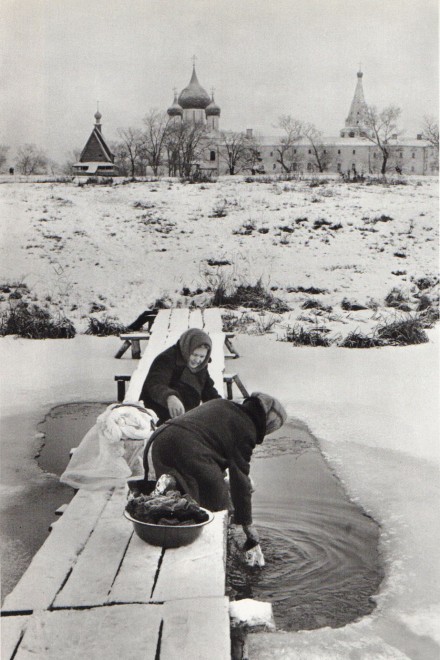
Washerwomen by the river Kamenka, Suzdal – early 1970s
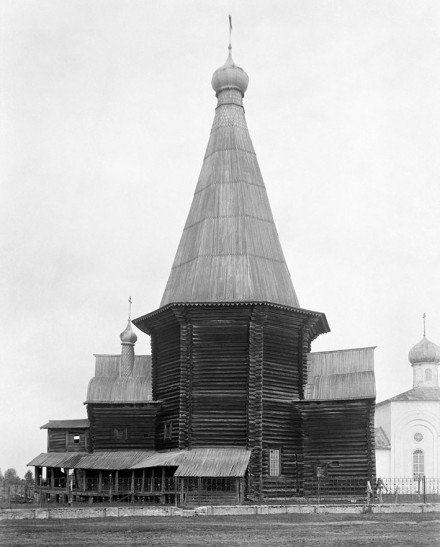
This photograph has been scanned from my copy of Henri Cartier–Bresson’s book ‘About Russia’ published by Thames and Hudson in London in August 1974 and no doubt bought by me in London in August 1974. £6.50 when £6.50 was £6.50. Cartier-Bresson made three trips to the Soviet Union, his book, published in 1955 in England as ‘The People of Moscow’ was the result of his first trip in 1954, the trips in 1972 and 1973 resulted in ‘About Russia’.
Last week I bought a pristine copy of ‘Mosca’ the Italian edition of ’The People of Moscow’ in the wonderful bookshop Hoepli in Milan. They had several copies, no doubt they had recently been discovered in a box at the back of a cupboard. ‘Mosca’ cost me 100 euros – £4.25 in old money (1955) so not a bad price. That got me looking at my Cartier-Bresson books on my return and ‘About Russia, turned up this photo of a wooden church. I’m pleased to say that it still exists. It is the Church of St Nicholas (1766) from the village of Glotovo. It was transferred to Suzdal in 1960.
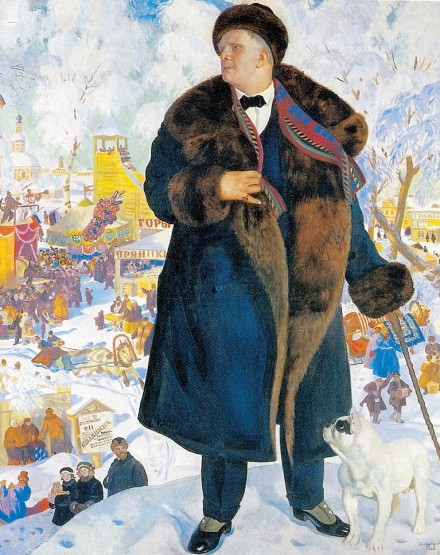
Feodor Chaliapin painted by Boris Kustodiev (1878-1927) 1922
Last weekend I went to Vienna to see a performance of the opera Khovanschina by Modest Mussorgsky. It’s an opera I’m always keen to track down. The music and the story are very powerful but apart from that I’m always intrigued to see how the final scene will be presented on stage. A scene where a community of Old Believers martyr themselves in a burning church rather than give themselves up to be slaughtered by the czars troops. Not an easy thing to stage.
I had great hopes for this production as it was directed by Lev Dodin. But despite a set made of charred timbers, no ‘coal effect fire’ lighting was attempted and no wind machine blown red silk used. And the protaganists and chorus were slowly lowered below stage, not raised to heaven. Apart from that the singing was great and the Vienna State Opera Orchestra conducted by Semyon Bychkov sounded wonderful.
Another plus was an English language programme where I came across this quote from Chaliapin ‘As a composer, Mussorgsky sees and hears all the scents of a garden or a tavern, and describes them so strikingly and persuasively that the audience finally hears and shares those aromas… That is realism, to be sure, but a realism of a special kind, such as we are familiar with from Russian peasants who with plain timber and simple axes build a church whose artistic ornamentation surpasses even the best inlaid work.’
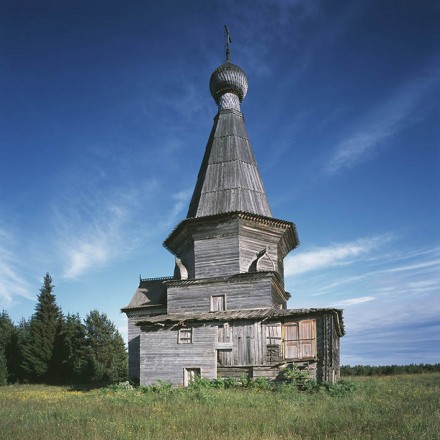
The Church of St Nicholas, Purenema, Archangel Region, July 2012
‘My chief hope for this book is that it may help to make others think of Russia, not as an abstraction, not as a unit, but as a very large number of very interesting human beings, most of them lovable.’ – In a Russian Village Charles Roden Buxton, Labour Publishing Company, London 1922
Russian Types & Scenes is a companion volume to Wooden Churches – Travelling in the Russian North. Photographing the churches was exciting and exhilarating but it was also frustrating. My camera was attached to a tripod. I faithfully gave my attention to the tripod and its camera, adjusting the position, the level, the height, the framing, the focus, the shutter speed and the aperture while brushing away snow, rain and mosquitoes from the lens. I knew that if I was to move away for a moment the sun would burst through the clouds; a dog, a cow, a horse or a wonderfully exotic Russian would hove into frame. Meanwhile all around me extraordinary everyday things were happening…
I did take some photographs away from the tripod but our schedule was tight and there was little time to loiter – a prerequisite for reportage photography. The majority of the photographs in this book have been taken since the publication of Wooden Churches. I’ve continued to travel to the Russian North with friends, journalists, restorers, students and film makers.
On most of these trips I’ve left my tripod at home or at best kept it deep in my luggage, to be called upon to photograph a church I haven’t photographed before. I now travel with a light handheld camera. The schedules have been slightly less demanding, although no less adventurous, but more importantly with less to carry and to take care of, there has been more time and energy to loiter.
Russian Types was the generic title the St Petersburg photographer William Carrick (1827-78) gave to the photographs he took of tradespeople, peasants, priests and officials in his studio and later to the scenes of Russian life taken in the ‘field’. This genre became very popular and was taken up by many photographers, artists and postcard publishers well into the 20th century.
A story from Solzhenitsyn explaining the shortcomings of colour photography follows in lieu of an introduction.
Richard Davies, London, June 2014
~
Along side the photographs there are texts by the Moscow architectural historian Alexander Mozhaev, together with the insights of writers, artists, and poets.
The first bread!
Tell me, who of you has never enjoyed eating a slice of bread from the new harvest?
How nicely it smells. It’s a smell of the sun, of fresh straw, and most importantly, of the combine driver’s hands soaked in kerosene.
Five Romances on Words from Krokodil Magazine, № 24, August 30th, 1965, opus 121 Dmitri Shostakovitch (1906-1975) first performed Leningrad, 28th May 1966
It’s hard to say something about Pushkin to a person who doesn’t know anything about him. Pushkin is a great poet. Napoleon is not as great as Pushkin. Bismark compared to Pushkin is a nobody. And the Alexanders, First, Second and Third, are just little kids compared to Pushkin. In fact, compared to Pushkin, all people are little kids, except Gogol. Compared to him, Pushkin is a little kid…
Today I Wrote Nothing ~ The Selected Writings of Daniil Kharms (1905-1942), translated by Eugene Ostashevsky, Ardis, New York 2009
It was Easter day, 5th May 2013, and that evening I did my usual rounds to make sure that everything was shut up properly before going home. During the summer I always come out to do a final check at about 8 pm, because there are children playing out until late, there are visitors around and the grass is tinder dry. So that evening, at about 7.40pm, I cycled back to the churches. There were some children playing volleyball nearby, I stood on the porch of the Church of the Epiphany, everything seemed fine, so I decided I could go home. On the way back I noticed storm clouds gathering in the direction of Kenozero. As I reached the cafe I run, I noticed some people at the bus stop. I told Elena that it was spotting with rain and that I would go home before the heavens opened. On my way back there was a flash of lightning. I got home at 8.45 pm to find Maxim and his wife had come round. I told my husband to turn off the television because there was an electric storm brewing. As soon as I sat down at the table with my tea, there was a tremendous noise outside and three minutes later the telephone rang. It was 8.50 and Elena was screaming down the phone, “Lyuba, come quickly, the church is on fire!” As I was rushing out of the house, my husband said, “What’s happened?” and I cried, “The church, the church!” Suddenly I pulled myself together and remembered that, as church warden, it was my responsibility to contact the fire brigade. So I told the others to go on without me.
Having rung the brigade, I ran out and as I drew near the Intercession church I could see children milling around and I could see the cross at the top burning with a tiny flame. Bits of the burning cross were falling to the ground and people were stamping them out. Then a piece fell off and instead of landing on the ground, it got stuck on the tent roof. I started yelling at everyone to open the church and save the icons. My husband comforted me saying that it was starting to rain and the rain would put out the fire. No sooner were the words were out of his mouth than it stopped raining and as I looked up I saw, with horror, that one of the cupolas was alight. A fireman later explained that although it had not been obvious to us at first, the fire had probably spread down the cross into the inside of the wooden roof area, at quite an early stage. Then I decided that we all had to go into the church and save the icons. When we got inside, it was dark of course, there wasn’t any interior lighting and we didn’t have any fire fighting tools with us, not even axes. So I issued the order to break into the iconostasis in whatever way we could in order to pull out the icons. My brother had been up near the roof trying to quench the fire with two small domestic fire extinguishers. But it was hopeless. He came down and helped to put up a ladder inside the church to reach the sky ceiling and I stood below, shouting out instructions where to begin, because I knew that the sky ceiling had been cleverly designed, so that if you take out one particular piece in a corner, then all the other images can be slipped out of place quite easily. But you have to twist that one piece in a certain way to get it out. There were three men trying to put out the fire in the roof, but when they realised it was hopeless, they climbed down, shutting the doors behind them to try and contain the fire. By this time I was really frightened that we would lose all the icons and was shouting at everyone to do anything they could to break the iconostasis apart and get them out.
The trouble is that respect for the church is deeply ingrained in our people, no one would dream of causing harm or taking anything from a church, it’s a great sin. So no one would come forward. Luckily, there were more people arriving and I was able to explain that we can rebuild the walls but it would be impossible to replace the icons, they must be saved at all costs. There were a lot of children there and I must say, if it hadn’t been for them, things could have been much worse. It was the children who initially raised the alarm, then they helped us and the firemen to carry out the icons. We managed to save 36 of them. We saved the big image of Christ from the first floor level. It felt as though we had been ferrying icons out for over an hour, but when I saw the video of it afterwards, it turned out to be only ten minutes. First of all we put the icons on the covered porch of the Epiphany church for safety, but when the bell tower caught light, we realised with horror that we had better move them further away, just in case. You can imagine the scene: it’s dark, the ground’s uneven with bushes and ruts everywhere, the church is in flames, everyone’s panicking, afraid that their house will be the next to catch fire, everyone’s staggering around carrying heavy icons. Oddly enough, the men didn’t notice how heavy they were during the rescue, but the next morning, when they came back, they found that they couldn’t lift them. Luckily, there’s a kind old lady who lives not far away, Nina Valentinovna Ivanova. As soon as I asked her, she agreed to have all the icons brought to her house for safety. She sat up all night guarding them.
This is a village where tradition is everything. Some of the villagers started processing round the exterior of the church carrying some of the most revered icons. When the flames started licking around the Epiphany church (you can see where the timbers are darkened), one of the firemen told me to take my icon and to stand at the corner of the church, between it and the one that was burning. And as I stood there with this most beautiful building burning fiercely in front of me, it was so hot that the icon in my hands heated up as though it was boiling water. I held it up in front of me and the flames kept on approaching and then recoiling and I had the feeling that I was doing battle, that there really was a chance that the Epiphany church might be spared. Afterwards, our tears were mixed with joy. You see, we had suffered a huge loss, words cannot describe it, we had lost the best thing the village had. What is Lyadiny without its churches? Yet at the same time, we had managed to save one of our churches. You see, regardless of what political system has been in power, in Lyadiny we have always respected and looked after our churches. They were built by our ancestors and handed down to our care and we have always taken this seriously. So now we feel at a loss. That beautiful building, crafted by our skilled ancestors, has been lost. Yet, whenever I look over this way, in my mind’s eye I still see it standing there, looking magnificent. It will always be with me and we will always celebrate the patronal feast day of the Intercession of Our Lady (Our Lady of the Veil).
You know, there was something that happened, it was about six years ago, when a group of tourists came here. It was when restoration work had just started on the Epiphany church, by a group of carpenters working in the traditional local style. I happened to be standing on the road watching them, when a car came up and the driver, a man, started asking me about the churches, what date they were and so on. I told him that, thanks be to God, we had managed to raise enough money to restore them. The man replied that the work would take years and that I would not live to see the end of it. So, I said that maybe, but that my two sons would and that this was the important thing. In Lyadiny we have always understood that what you build today is for tomorrow’s generation. So that’s how we Lyadintsy (people of Lyadiny) defended our church. And we won’t give up. We won’t accept second best. We will rebuild a proper church to replace the lost one. It may take ten or even a hundred years to build, but it will be a worthy successor and something that we are proud to hand on to subsequent generations. When it’s finished we will be weeping tears of happiness, not like today, tears of grief.
Liadiny was blest with a magnificent collection of wooden church architectecture.
St Blaise’ Church of the Intercession built in 1761, the Church of the Epiphany built in 1793 and a fine 18th century bell tower. It was one of the few remaining three-part ensembles in Russia – summer church, winter church and bell tower. The Church of the Intercession had, unusually, retained its iconastasis resplendent with many icons together with a beautiful heavenly blue sky-ceiling.The churches had survived their desecration during Soviet times when they had been used as barns but sadly the Church of the Intercession and its bell tower are no more. The Church was struck by lightening on the 5th May this year – Easter Sunday.
links below to Matilda Moreton’s account of the tradgic events in English and Russian
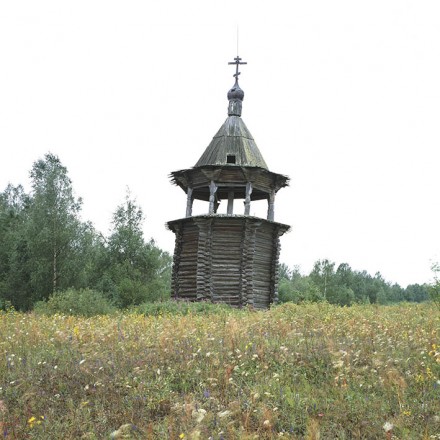
I’m just back from a visit to the wonderful masterpiece of wooden architecture in the Archangel region of Northern Russia – the bell tower at Tsyvozero. I was joined by Alexander Popov, the restorer of wooden architecture based in Kirrilov, the wooden architecture enthusiast Andrei Pavlichenkov, the journalist and campaigner Alexander Mozhaev and my friend Alex Popov from St Petersburg. We were all horrified by what we saw.
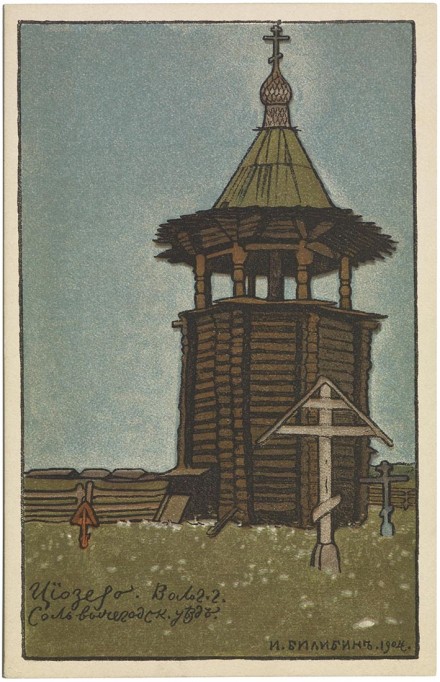
Bilibin’s Tsyvozero postcard pub. 1904
In 1904 the bell tower was described by Bilibin as ‘a most adorable tent bell tower… She is living her last days, she has leant over sideways and trembles in the wind. The bells have been taken from her.’
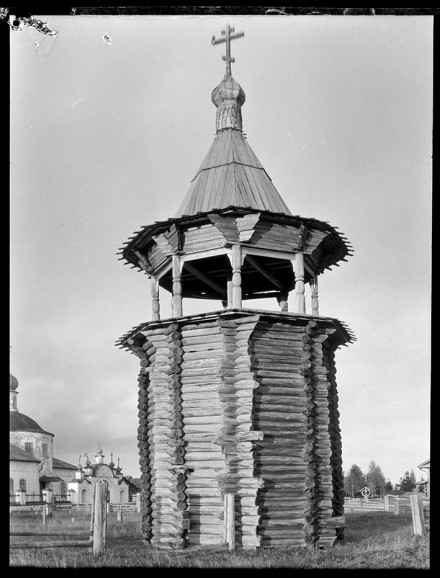
David Buxton’s photograph Tsyvozero 1932
In 1932 David Buxton wrote ‘In the evening it brightened up, and off I went to view the object of my visit – a delightful old wooden bell tower of the smallest dimensions, but pleasing in every way.’
17th August 2002
When I first visited Tysvozero in 2002 the bells were certainly missing but the tower stood proud and erect, albeit dishevelled.
7th October 2012
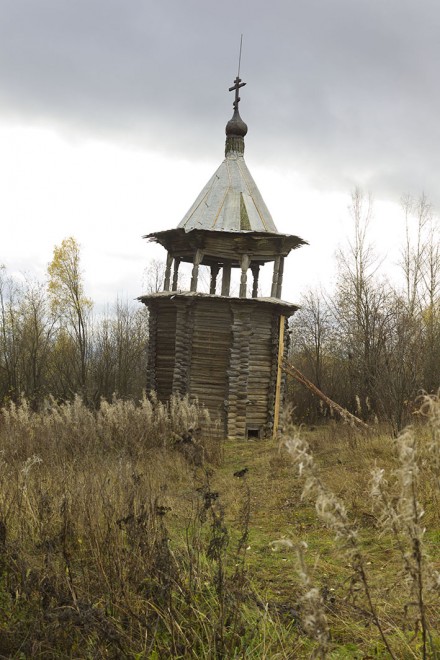
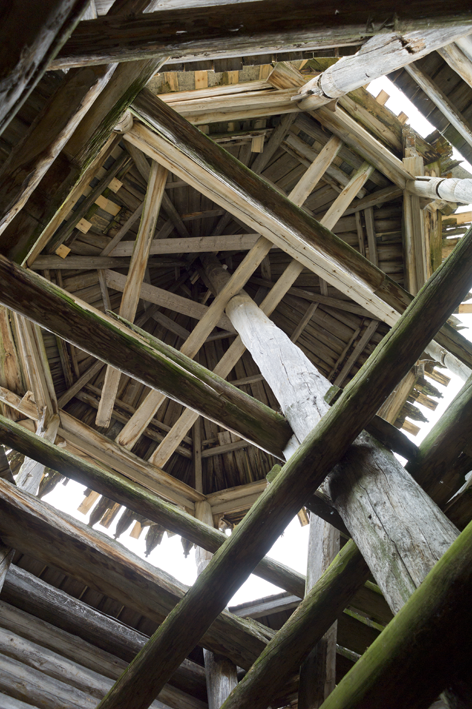
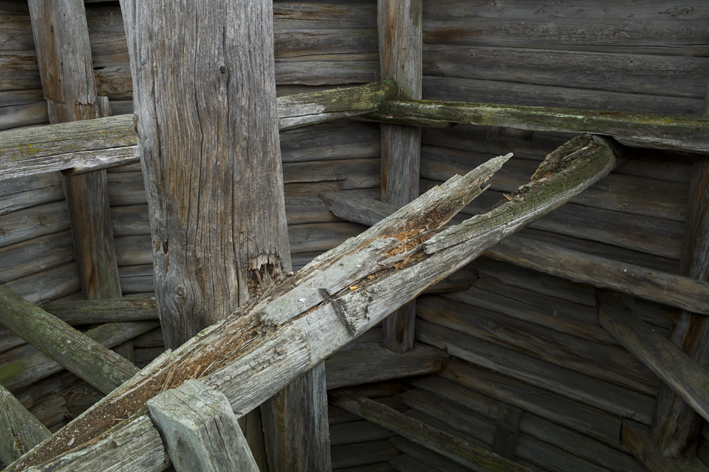
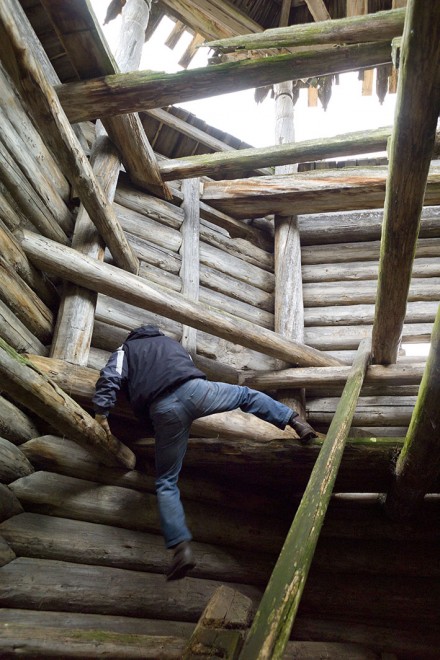
This time, the 7th October 2012, the bell tower was showing her age. She was propped up, her roof battened down with roofing felt. Many of her logs were rotten or showing signs of rot. In 2002 I’d had no problem climbing within the tower, this time the stairs had collapsed and the route to the top was very precarious indeed. Concerned about the authorities neglect of this great work of Russian art local villagers had recently carried out the remedial work.
Alexander Popov
The purpose of our visit was to assess the structure with a view to obtaining permission to support the local people in their desire to restore the bell tower. We were confident that we could find backers in England and Russia to support the project. Alexander Popov, the restorer, is a great admirer of this beautiful bell tower and was keen to use his skills to preserve it.
Having seen the bell tower we were all shocked and downhearted – what could be done? The project had seemed straightforward but now we wondered if Tsyvozero was beyond repair.
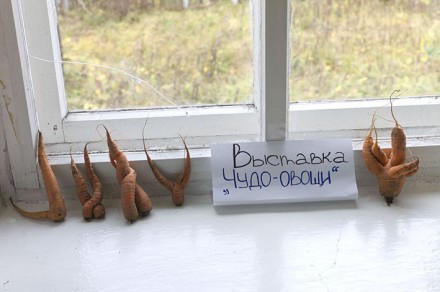
We spent the next few hours in Belaya Sluda with teachers from the school and kindergarden, Galina Kornyakova and Luibov Khabarova. We visited the schools famous Mushroom Museum and paid homage to the King of Mushrooms, who resplendent in all his finery, sat on his throne surrounded by his subjects. We saw an exhibition of ‘miracle vegetables’.
‘Miracle vegetables’ exhibition
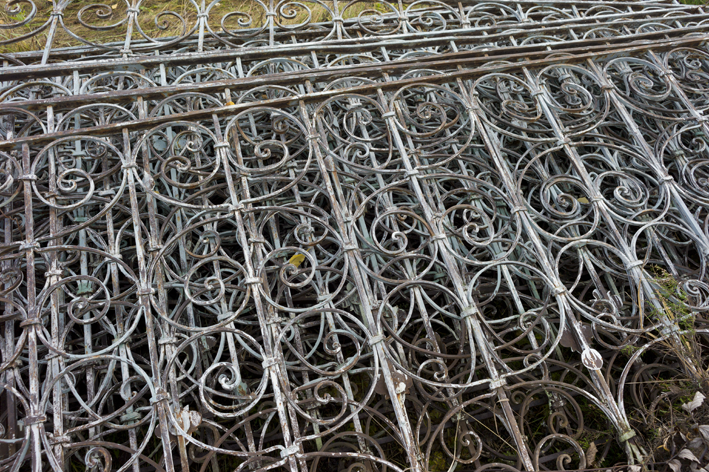
The school proudly displays on it’s walls photographs and models of the local treasures – the Church of St Demitius of Thessolonika at Verknyaya Uftiuga that Popov had restored in the 1980′s (Luibov was thrilled to meet her hero) and of course the bell tower at Tysvozero. There was an old photograph of the Church of the Virgin of Vladimir at Belaya Sluda. It had been destroyed in 1962. Galina was eight years old at the time and remembers the thundery day. The church was hit by a single bolt of lightning and burst into flame. Men climbed onto the roof to throw down the burning timbers but the fire was too fierce and flamming like a huge out of control candle the church burnt to the ground. With Galina and Luibov we visited the site of the Virgin of Vladimir, I showed them Buxton’s photograph from 1932. Luibov became very excited, the photograph showed the railings in front of the church and the stone church that had survived. Luibov and the villagers have re-inhabited the stone church and she now wants to reinstate the railings. She has collected twenty seven of the original sections from around the village. The photograph showed that they had been placed slightly differently from how she had imagined!
David Buxton’s photograph Belaya Sluda 1932
Luibov Khabarova and Galina Kornyakova
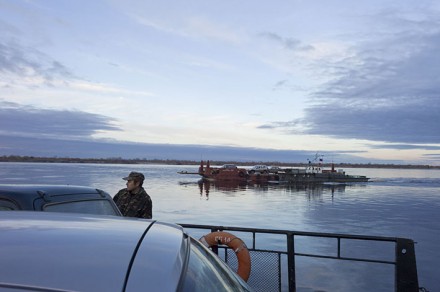
After tea, mushrooms and sweeties in the school staff room we set off to catch the last ferry back across the Dvina to Krasnoborsk.
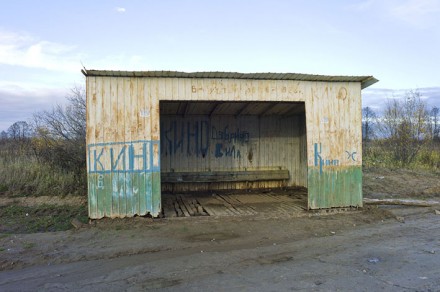
‘Кино’ Dvina ferry shelter
Dvina ferry to Krasnoborsk
On the drive back to our hotel in Veliky Ustiug Popov was disturbed and expressed his anger at what we had seen at Tsyvosero – how could this extraordinary icon of Russian wooden architecture be left to its fate without some effort being made to preserve it. Again we considered what could be done. We all agreed that ideally wooden architecture should be preserved were it stands, it has a greater resonace, but Tysvozero is almost beyond hope. It could be protected from the worst ravages of the elements with a canopy but it’s beauty would be destroyed. The ideal at this stage, we eventually agreed would to carry out a thorough survey of the bell tower, dismantle it and rebuild it in a purpose built top lit structure (the hall housing the Elgin marbles in the British Museum came to mind!). Sasha Moshaev suggested that the Tsyvozero bell tower replace the copy of Michaelangelo’s David under the dome of the Pushkin Museum in Moscow. An authentic Russian masterpiece replacing an academic sham. It would look magnificent! The Marble Hall at the Ethnographic Museum in St Petersburg would also be a perfect setting and a wonderful tribute to Bilibin. For during the early years of the last century Ivan Yakovlevich Bilibin collected artifacts, and recorded with photographs and paintings the folk art and wooden architecture of the North at the behest the Russian Museum.
A replica using the traditional working methods studied and perfected by Popov could then be built on the original site – it could safely be left in the hands of the local community whose young people have been encouraged and taught to appreciate and respect their heritage and homeland. In time the tower would accrue the patina of the old tower. Hung with a fine set of bells she would awaken new life and energy.
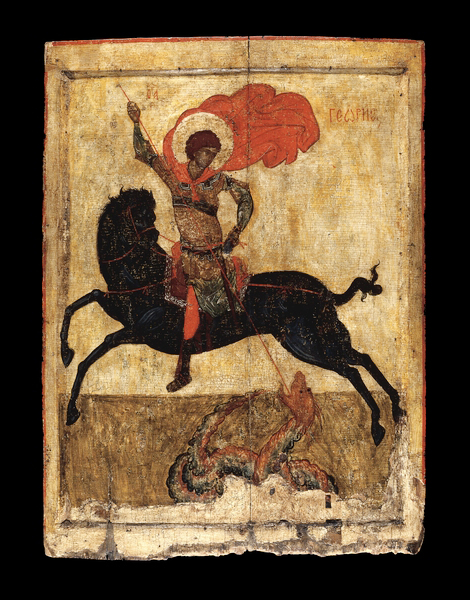
Icon of St George slaying the dragon ‘Black George’
On a recent visit to the British Museum I came across this beautiful icon.
It was found in 1959 in a small village in the district of Ilinsky on the Pinega river in Northern Russia by Maria Rozanova, wife of the prominent dissident author Andrei Sinyavsky. It was being used to shutter a barn window. When found all that was visible was an eighteenth century folk painting. Later in Moscow, under the hands of a professional restorer, various layers were stripped off to reveal this extraordinary image of St George slaying a dragon. Experts dated it to the end of the fourteenth century and attributed it to an artist from Pskov. St George sits astride a black rather than the usual white horse, hence Black George, cooly lancing a dragon in the mouth. The red cloak encircling and billowing behind his halo gives him flight.
When in 1973 Sinyavsky and his wife were allowed to leave the Soviet Union they were able to take their possessions with them. The British Museum purchased the icon from them in 1986.
In his book Ivan the Fool Russian Folk Belief Andrei Sinyavsky (translated by Joanne Turnbull and Nikolai Formozov published by Glas Moscow 2007) tells us that……. In Old Russia George, like Nikola, had two feast days, April 23rd – Spring Egory, and November 26th – Cold Egory: important dates in the agricultural calendar marking the beginning and the end of summer labours. On Egory’s day in spring, the peasants began to plough the fields and sow the first spring crops. The weather on that day was considered an omen. Common folk sayings went like this: “Frost on egory means millet and oats.” Or: “Dew on Egory means good millet.” Or: “If it rains on Yuri, the cattle will have an easy year.”………everything in nature begins with spring Egory………
Yuri, get up early and unlock the earth,
Let out the dew for a warm summer,
And a riotous wheat harvest….
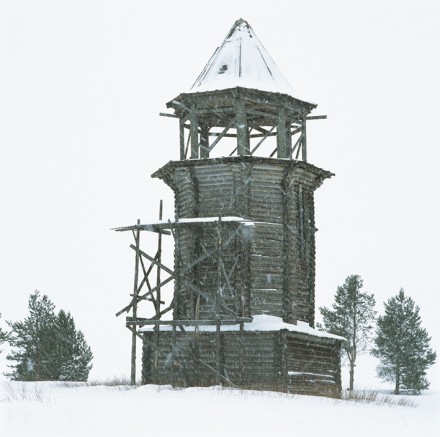
I visited the Pinega river in search of wooden churches in February 2005.
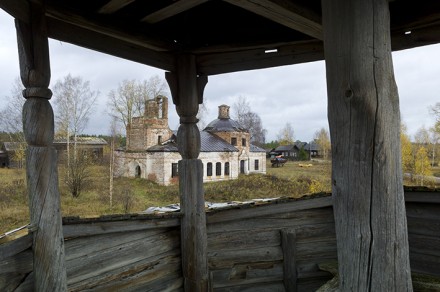
Diary entry 26th Feb 2005 – Early start – the sun (red, beauteous & wondrous) has just risen – the landscapes tingles with sparkling frost – we pass four lads setting off to the forest with an auger, fishing tackle and a kettle – we drive over the Pinega river and through the forest – the road twists and turns and careful Leonide drives with caution, 80 km and two and a half hours later we arrive at Pirenem to learn that it’s beautiful 17thC church which had stood on the embankment overlooking the river burnt down twenty years ago (my reference book was printed in 1976) – do the other two churches beside the Pinega river survive – at Yedoma I am relieved to spot the church in the distance across the river – a young fellow tells us the route to the church is only suitable for horses – Leonide sees a horse and runs off to make arrangements with its owner – Slava fixes a sleigh to the horse and Alex and I (Leonide stays with his YA3) are soon on our way – in my excitement to photograph Alisca’s (the horse) backside I lose my balance and tumble into the snow – the ride is wonderfully exhilarating – on arrival in the village we learn that the church is a kilometre further on and that the snow will be up to our waists – one of the five winter inhabitants of Yedoma an old man in need of cosmetic dentistry kindly offers us two pairs of skis which we gratefully accept – mine are not a matching pair and the fixings are not the latest but who cares – Alex sets off at quite a pace and Slava gamely follows in his felt boots sinking deeply into the snow whenever the frozen crust breaks - I proceed cautiously but not cautiously enough and soon topple, floundering like an upturned beetle – I eventually right myself and continue – before reaching the church I have toppled a few times more and arrive dressed as a snow man – the fully extended legs of my tripod sink into the snow but enough sticks out to take the camera – the next trick is manoeuvring around a tripod with barely controlled skis – the Church of St Nicholas (1700) is without the stunning tent roof shown in the photograph published 1976 but the bell tower standing to the side looks handsome in the gently falling snow -
Bell Tower Yedoma February 2005
on our way back to the sleigh Alex asks Slava to follow me and to pull me out when necessary – I’m pleased to say it wasn’t necessary – Slava is a good looking 25 year old with blue eyes and ruddy cheeks, he is married with a two month old daughter – he works as a truck driver but work is difficult to come by – his last employer (the bastard) strung him along for three months without paying him even the pittance he had agreed – Leonide has been told that the Church of the Prophet Elijah (17thC) at Verkola still stands so we pay Slava (generously) and set off – the church is sited above the Pinega river near an old monastery – a monk chopping wood gives us directions – the church has been restored, no doubt by the enthusiastic monks, in a very DIY fashion and the double glazing wide boy who sold them the replacement windows was obviously not cognizant of the fact that he was dealing with a 350 year old Grade 1 listed building – at least the weather has been kept out for a few more years.
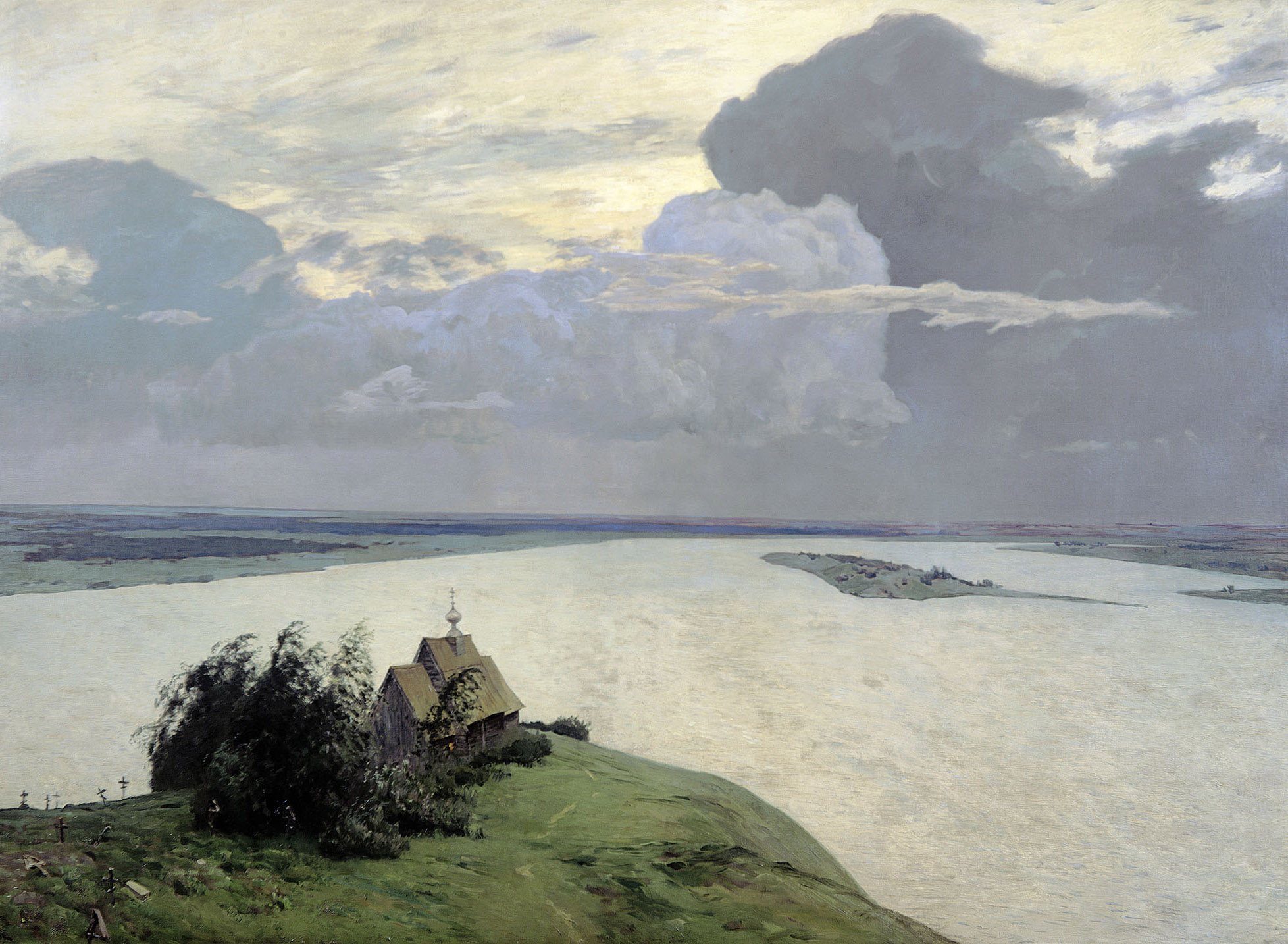
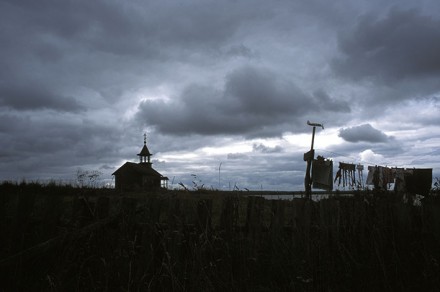
On every trip I’ve made to Russia to photograph wooden churches I’ve kept one image in my minds eye – Levitan’s extraordinary painting Above Eternal Peace. The blurb at the Tretyakov Gallery where it hangs describes it vigorously – ‘A boundless water expanse of nearly cosmic dimensions embracing an islet with a defunct chapel and neglected cemetery, brings to mind the grandeur and eternity of the Universe, the smallness of man the brevity of life.’ In fact on close inspection it seems the church is not defunct, a tiny light glows from a tiny window. At Kondoberezhnaya on Lake Onega I found the chapel, I found the sky, I found the lake but however much I twisted and turned to contrive the image in the viewfinder the various elements refused to come together. I had to settle for a photograph of the sky, the chapel, a sliver of lake and in the foreground a washing line hung with woollen tights, shirts and towels, with a whittled model aeroplane weather vane atop the pole at one end of the line, it’s propeller turning in the breeze – Below Eternal Domestic Chores.
Kondoberezhnaya Aug 2003
Averil King’s beautiful book Isaak Levitan Lyrical Landscape gave me the clue I was looking for ‘the summer of 1893 saw Levitan working near Lake Udomlya at Vyshni Volochek. This visit resulted in the composition of the picture he considered to be his greatest work Above eternal rest, which he finished the following year’.
The search starts from the small flat of a Moscow friend, Polina who lives on the 16th floor of one of the seven gigantic Stalin wedding cake towers that dominant the Moscow skyline. Vysotkana Kotelnicheskaya sky scrapes beside the Moscow river. We leave later than hoped at 9.30pm pausing briefly in her kitchen to watch the sun dip behind the Kremlin.
The traffic that we hoped would have cleared is still bad. We crawl slowly from Moscow on the old Vladimirska Road, now the M7. This road was famously painted by Levitan in 1892. Again to quote Averil King ‘the ancient road formed the route taken by generations of prisoners……… Levitan started as he recognised the road, calling to mind “the many unfortunate souls who trod the road, clanging their chains, on their way to exile”….. It is a picture filled with sadness and foreboding……’ The road is now filled with huge articulated trucks and the infamous Moscow black painted four-wheel drive spiv wagons. After an hour the traffic begins to move, a very bad accident on the opposite carriageway had stunned the traffic to a mournful procession.
Roadside selling is big in Russia, dried mushrooms on strings, berries in buckets, preserved beetroot in bottles etc. are the norm but a dozen floodlit stalls selling metre high fluffy pink bunny rabbits with 1 ft long floppy ears in tightly sealed clear plastic bags is strangely shocking. Polina while no doubt musing on this bizarre phenomenon drove through an amber light on the outskirts of Vladimir and was flagged down and dragged off to be questioned by a policeman. On this occasion she refused to bribe the officer and was duly issued with a writ to pay a fine of 700 roubles within a month. It’s around midnight so we stop at a night-club in Vladimir for a coffee and to catch up with the semi-final results of the Eurovision song contest while laser lights explode on a medieval brick vaulted ceiling.
The sky is clear and full of stars, mist is settling in over the fields as the sky brightens in the east – we arrive at our b&b Private Visit in Plyos at 4 am to be greeted by sleep deprived but still smiling Natalia. We look down on the glowing Volga. The early morning is alive with birdsong.
Late breakfast (Zavtrak) – Toplonoye moloko – Bliny – Tvorog – Syrniki – Oladyi – and a small lidded bowl of delicious porridge sprinkled with tiny pieces of strawberry.
At the I.I.Levitan Memorial House-Museum on the embankment we meet Olga Viktorovna Nasedkina (Olga by the Volga) the director of the Museum and her two colleagues Olga and Larisa. Over tea and biscuits (a bottle of Rioja presented by Spanish visitors is offered but pathetically declined) Olga tells us of Levitan’s time in Plyos.
It seems that when travelling by boat on the Volga with his mistress Sophia Petrovna Kuvshinnikova during the summer of 1888 he spotted a wooden church on the hill above the town. The Church of St Peter and St Paul was no longer in use and closed. Levitan asked the priest to open the church and Sophia Petrovna insisted that the priest conduct a service. The story goes that Levitan was so worried that the lighted candles would burn the tinder box down that he wept. Having seen a reproduction of the painting Levitan painted of the Iconostasis in the church I’m sure that Levitan was moved to tears by the beauty of the occasion.
It is this church on it’s hill above the Volga that Levitan used as the model for the church in ‘Above Eternal Peace’.
A representative of the Moscow Archaeological Society, Jacob Uspensky had visited the church the year before Levitan and studying the monuments within it determined that the church had been built in the 16th century. Sadly this church was destroyed by fire in 1903 and a small stone church was built nearby to replace it. During Soviet time this was turned into an electricity substation. In 1974 a project was instigated to find a wooden church to stand on the original site of Levitan’s church. As Olga explained two rabbits were killed, this I initially took to be some kind of orthodox/pagan ritual performed to placate God/gods when you start moving churches/temples around but Polina later explained that it was a device whereby you killed two birds with one stone.
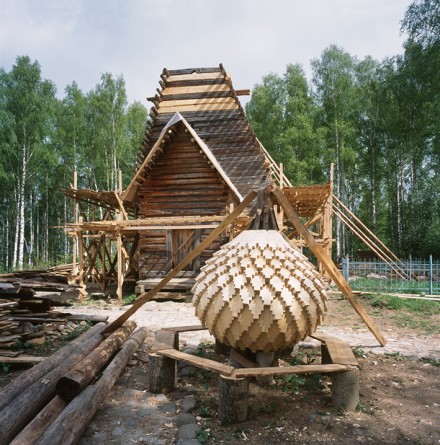
An unloved church was found in the deserted village of Bilakovo, Ilinsky district in Ivannovskar Oblast. The Church of the Resurrection although built in the 17th century was of a similar design to the Church of St Peter and St Paul. It was dismantled in 1981 and rebuilt on its new site under the direction of the famous restorer of Russian wooden churches Alexander Opolovnikov. The restoration was completed in 1987. Signposts in the town now refer to it as the Wooden Church Eternal Peace; the hill on which it stands which was called Peter Paul is now named after Levitan. The church has again been dismantled and is in the process of being reassembled with rotten timbers replaced by new.
Wooden Church Eternal Peace 16th May 2009
Plyos is beautifully situated on the steep bank of the Volga River. The name comes from the word plyos that denotes a straight length between two turns of a river. The town was founded in 1410 by Vasily I, the Prince of Moscow and the son of Dmitri Donskoi.
Levitan spent three summers here in 1888, 1889 and 1890. After the rain painted in 1889 is probably his most celebrated image of the town. Other famous visitors were Chekhov and Chaliapin.
From Plyos we set off to drive to Lake Udolmya. We take our time. My Google research had thrown up a few interesting facts, not least of which is that Lake Udomlya now plays host to the Kalinin Nuclear Power Plant. Knowing that Prime Minister Vladimir Putin had chaired a meeting at the Kalinin Nuclear Power Plant on the 15th April 2009 (23 years to the month after the Chernobyl disaster) and survived was reassuring. The press release issued by the Government of the Russian Federation containing the following conversation between Prime Minister Putin and the Head of the Kalinin Nuclear Power Plant Sergei Kiriyenkko removed any doubts we might have had about visiting the area.
Sergei Kiriyenko: As far as personnel exposure to radiation, you can see that the measurements indicate levels of zero radiation. Beginning in 2002 and 2003, the charts have shown no exposure to radiation, as such a condition does not exist at Russia’s nuclear power plants. Here, you can see a comparison chart between Russia and the world. The question on whether the nuclear energy in Russia is safe has been frequently raised.
Vladimir Putin: I heard that you have done some scuba diving here?
Sergei Kiriyenko: That’s right, I went diving here with the Governor.
Vladimir Putin: When was that?
Sergei Kiriyenko: Two years ago. There are a lot of fish here, by the way.
Vladimir Putin: Did you eat some?
Sergei Kiriyenko: We did, in fact; I highly recommend it.
Vladimir Putin: Very good.
Others have been equally satisfied with their visit to Udomlya as Oliver from Clear Lake USA testified to the Sincere perfect woman marriage web site (Sincere perfect woman. Make bookmark this marriage web site that is why as we’ll modifying this often) on the 10th August 1998 – I have had success quickly and thank you for genuine cupid marriage network. I should to date your funny ladies when I travel to Udomlya. I have met girlfriend from your community. Hopefully I must find the adventurous woman of my wishes here. Your agency is perfect quality network and again i want to thank you for your response.
Reading the Survey of the Parasites of Zebra Mussels (Bivalvia: Dreissenidae) in Northwestern RussiabyDaniel P. Molloy, I. Vitali, A. Rotman, and Jeffery D. Shields and the study on the Detection of radionuclides in the shell of the freshwater molluscs byMichael A. Zuykov, Stanislav I. Shabalev, Viktor P. Tishkov, Andrey I. Smagin, Yulia V. Plotkina, Maxim R. Pavlov, Marina I. Orlova and Thomas Servais both produced by studying specimens found by the shore around the power station does little to dent our confidence as the report and conclusions are written in such gobbledegook that for us ignorance is bliss.
Our journey from Plyos to Udomlya, like any journey in Russia throws into our path moments which highlight the beauty and the tragedy of this extraordinary country.
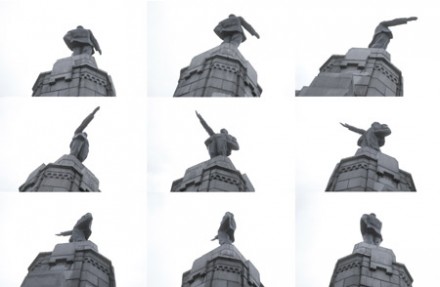
In Kostroma a huge statue of Lenin with his right arm outstretched points to a future he could never imagine, no more than Nicholas II could have imagined the future when he came to Kostroma in 1913 to dedicate the foundation stone for a great monument in the city park that would honor 300 years of Romanov rule. At the dedication Nicholas II threw a handful of gold coins into the cement. The pedestal for the monument was finished and then on July 17th 1918 the Tsar and his family were murdered in the basement of the Ipatiev house in Ekaterinburg. Ten years later in 1928 J.V. Stalin sent a message to the workers of Kostroma – ‘Fraternal greetings to the workers of Kostroma on this First of May, the occasion of the unveiling in Kostroma of a monument to Lenin, the founder of our Party! Long live the workers of Kostroma! Long live May Day! May the memory of Lenin live eternally in the hearts of the working class!’ The Romanov pedestal and the Tsar’s gold were used to support the towering Lenin.
Kostroma Lenin 17th May 2009
In 1934 the Kostroma Kremlin together with the Assumption and the Epiphany Cathedrals were blown up by the communists. The Trinity Cathedral (1652) at the Ipatievsky Monastery survived and a service is taking place when we visit. An all male choir is singing gloriously; they drink tea and check their mobile phones when at ease. The interior walls are covered in beautiful frescos painted in 1684 by the Kostroma master, Guri Nikitin and his team of icon-painters. A magnificent five tiered gilded Iconostasis has also survived, made by the Kostroma woodcarvers Piotr Zolotariov and Makar Bykov in the 1750s.
In a village outside Kostroma a wing clipped Aeroflot aeroplane has landed in the garden of a small house and the Lenin Kolkhoz slowly disintegrates in the shadow of the Romanov Forest Hotel.
Between Ivanovo and Jaroslavl in the village of Osenevo we stop to photograph the stone Church of Kazansky Mother of God. The church was broken in the thirties and the bells were thrown from the bell tower. A man and his wife working in their garden tell Polina that the priest was sent away and died in prison and that all the communists who took part in the destruction of the church died of heart attacks. The cladding from the five onion domes has been stripped away by time; only the structural skeletons remain. A semblance of the pre-revolutionary village encircles the church, ducks and geese swim in the village pond, old wooden izbas are dotted around a rich green meadow and water is still drawn from a well.
At Jaroslavl we check into the Bears Corner (a quiet empty place in the forest rarely visited by man) Hotel – then drive to the village of Nikulskoye for supper at the Valentina Vladimirovna Tereshkova Cosmos Museum restaurant. Tereshkova was the first woman and first civilian to fly into space on the 16th June 1963. Her call sign was Chayka (Seagull). She orbited the earth 48 times and spent almost three days in space, which was more than the combined flights times of all American astronauts at the time. Her selection for the space program was shrouded with great secrecy. Tereshkova reportedly told her mother she was going to a training camp for an elite skydiving team. Her mother only learned she was a cosmonaut when the flight was announced on Radio Moscow. Sadly the food does not come in foil packaging and the drinks are not served in zero gravity flasks but at the end of a countdown the lights dim and the engines attached to the re-entry capsule decorating one end of the restaurant explode into life. Red lights flash, bits of flame shaped silk are wind machine blown to represent flames, smoke fills the restaurant, the waitress coughs, splutters and waves her arms frantically to clear a passage to the kitchen. From loudspeakers doted around the room there emanates a great rocket lift off noise which cross fades into the wonderful Stalinist anthem, sung no doubt by a major in the Red Army Choir -
We were born to make fairy stories come true
To conquer the boundlessness of space
Our reason has given us wings of steel (hands-wings)
And a heart like a fervent engine.
Higher and higher and higher
We guide the flight of our birds
And in every stroke of their wings
Our borders breathe in peace
As our compliant machine takes off
On its unprecedented flight
The promise of the world’s first proletarian fleet
Is strengthened and fulfilled
Higher and higher and higher
We guide the flight of our birds
And in every stroke of their wings
Our borders breathe in peace
Our sharp gaze pierces every atom
Each nerve is shining with determination
And, believe us, our Air Force
Will give answer to every ultimatum!
Higher and higher and higher
We guide the flight of our birds
And in every stroke of their wings
Our borders breathe in peace
The smoke clears, the flame shaped silk stills, the house lights dim up – ‘How was it for you Polina?’
We crawl from our Bears Corner as early as possible, the breakfast is not a patch on Private Visit in Plyos.
In Uglich we relive a pivotal moment in the history of Russia and of Russian Opera. The tragic story of Tsarevich Dmitri(1582 – 1591) is the basis of Modest Mussorgsky’s wonderful opera Boris Godunov based on Pushkin’s drama of the same name. Dmitri was the son of Ivan the Terrible and Maria Nagaya . After the death of Ivan IV, Dimity’s older brother, Feodor I, ascended to the throne. However, the real ruler of the Russia was Feodor’s brother-in-law, a boyar Boris Godunov. Godunov wanted to get rid of Dmitri, who was the legal successor to the throne in light of Feodor’s childlessness. In 1584, Godunov sent Dmitri, his mother and her brothers into exile to the Tsarevich’s appanage city of Uglich. On May 15, 1591, Dmitri died from a stab wound, under mysterious circumstances. Pimen the Chronicler in Pushkin’s drama tells what happens -
‘Then to the distant Uglich I was sent
On a certain mission. I came late at night.
Next morn, before the hour of service,
I hear a sudden toll – they sounded the alarm, -
Noise, shouts. People rush to the Prince’s yard.
I hurry with them – all the town is there.
I see: there lies the prince, his throat cut,
His mother – Queen beside herself with grief ,
His wet-nurse howls wildly in despair,
And people in anger drag across the yard
His nurse – the godless traitor…
Then among them, severe, pale with rage,
There appears the Judas – Bityagovski.
“Here, here’s the villain,” – was a common shout,
And in a moment – he was no more….
Prince Vassili Shuyski was sent to Uglich to investigate the killing of Dmitri. The consequence of which as so often in Russian history was more killing, torture and exile.
A false Dmitri occupied the throne after Godunov’s death. He didn’t last long.
Along the embankment things are more peaceful – three young men mobile phones in hand are listening to the powerful song of a nightingale. We spot it in a tree, a tiny bird, it’s mouth wide open, it’s throat pulsating throwing out an extraordinary sound. We had thought the listeners were recording the song on there mobiles, in fact they were playing their ring tones which they hoped the nightingale would mimic.
Yodel would be a challenge Marimba a doddle.
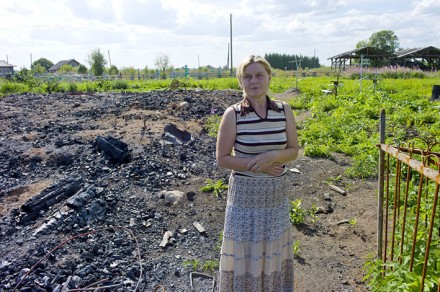
The weather is sunny and fresh. The blue sky is dotted with fluffy clouds. The meadows are springtime green as are the growing leaves of the birch trees. Bird Cherry blossom highlights the landscape. The rivers and streams are full to overflowing. Fields are being prepared for sowing and cattle are grazing. The countryside looks extraordinary. The villages are generally well kept although we note a surprising number of burnt out izbas. In one village the fire has flattened and blackened a swath of buildings. In another the old kolkhoz buildings are in ruins. A standing wall has the exhortation Glory to work picked out in red brick.
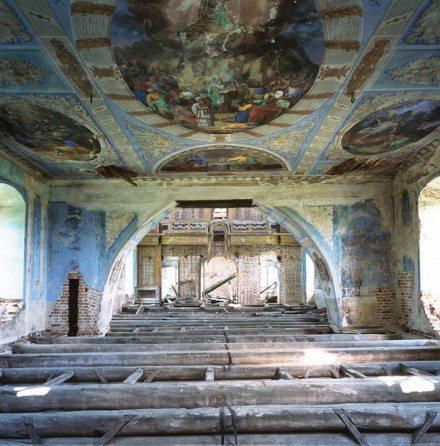
At the village of Archangelskoye (formerly, we later learn, Archangelskoye Mikhail) we stop to photograph another broken church. The church is on two levels, the winter church on the ground floor, the summer church on the 1st floor. Murals decorate the walls and ceilings where the plaster is still attached to the lath, but much has fallen or been defaced by graffiti. Amongst the desolation of the ground floor there are cheap icons pinned to the wall and candle stubs pushed into the now earth floor. The stairs to the first floor have disappeared but we scramble up and make our way into the summer church walking on the huge floor joists, the iconostasis remains sans icons and is daubed high up at tier four with the word Communist! Elsewhere there are pledges of eternal love to Lara, Olga, Lena, Zina, Katya, Natasha and Tatyana.
Church of Archangel Mikhail 18th May 2009
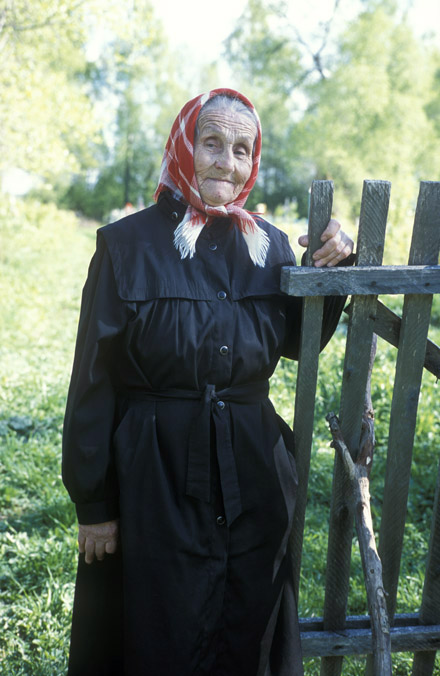
Outside I find an old 78 rpm Melodya record of Sergei Mikhalkov reading one of his famous children’s stories ‘Uncle Steeple’. While I have been taking photographs Polina has been trying to track some body down to tell us about the church but the village is deserted and the shop boarded up. As we are about to leave we see Raiisa Mihailovna Sokolova walking along the road towards us hand in hand with her sixty odd year old son. She is happy to tell us all she knows. The church was broken in the late fifties when the Kolkhoz was set up and the priest sent away. The walls surrounding the church and its magnificent portal were taken down so that the bricks could be reused. Although Raiisa describes herself as a bezbognitsa, a woman without faith, she tells us that when the church was functioning she took a great interest in the goings on. This she kept to herself, she was employed in the library by the local administration and would have been fired if her interest had become known. The church served many of the surrounding villages and Raiisa remembers seeing weddings, baptisms and funerals. She told how on one occasion the priest came to the library and proposed that she drink with him ‘ what will the cleaner think?’ the priest invited the cleaner to join them. Raiisa tells us the cleaner became very drunk but that she remained sober.
Raiisa Mihailovna Sokolova 18th May 2009
The village was thriving, it was an important local centre with a population of 1,700 people, there was a school (it closed last year, her daughter taught there), an old peoples home, a hospital and a club for dancing, films and wedding celebrations. The population is now 4, her son, another single man and an old couple, all retired. Raiisa lives with her daughter, the teacher in a neighbouring village. The shop closed recently because of a lack of customers and a surplus of thieves.
This year Easter (Paskha) was celebrated in the church by a priest from another place. As is the tradition in the Russian Orthodox Church, at midnight the congregation, holding lighted candles, processed around the church.
Raiisa then tells us of Ksenia Stritsa, a religious lady from a rich family who was able to foretell the future. She lived from 1842 until 1940 and her fame is such that people still come to visit her grave in the village cemetery. Raiisa invites us to visit the grave. Still hand in hand with her son she walk slowly through the village and points out the the site of the hospital, her library and where her son now lives. As we approach the graveyard in the forest she talks of eternal peace. Ksenia Stritsa’s grave is well kept and colourfully amassed with plastic flowers – the photograph attached to a cast iron cross shows a pleasantly stern old lady with her head covered by a large plain white babushka. Raiisa points out the graves of her other son who died in 2006 of an illness, of her father who died of old age and of her husband who died in 1945 overdoing his celebration of the Victory in the Great Patriotic War. As we say good-bye to Raiisa and her son we all acknowledge the happy coincidence of our meeting.
That evening we make it to Bezhetsk – Google comes up with the following information -
Bezhetsk: a city in Tverskaya oblast’, Russian Federation
Accommodation (0): There are no Accommodation entries for Bezhetsk. If you know of any, please add them now
Restaurants (0): There are no Restaurant entries for Bezhetsk. If you know of any, please add them now
Event Venues (0): There are no Event Venue entries for Bezhetsk. If you know of any, please add them now
Attractions (0): There are no Travel Attraction entries for Bezhetsk. If you know of any, please add them now
Transport (0): There are no Transport entries for Bezhetsk. If you know of any, please add them now
Other Facilities (0): There are no Other Facility entries for Bezhetsk. If you know of any, please add them now
Organisations: Our directory has no Organisation entries for Bezhetsk. If you know of any, please add them now
In fact there are three hotels in Bezhetsk. The Rus is full so we make do with the Prestige. Unfortunately they only have rooms available for four and three persons so the two of us pay for seven beds.
We eat at the Portal Night Club which we are happy to recommend, the clubbers played chess, the music was gentle and soulful and a patron very kindly offered to show me a good time. My present quest for Eternal Peace made this an offer I had, on this occasion, to refuse.
We crawl from our Prestige beds as early as possible, the breakfast is not a patch on The Bears Corner in Jaraslavl.
Another beautiful day; the final day of our journey. There is no sign of the lowering Levitan sky as we approach Udomlya. We’ve been landed with ‘a jolly nice spring day’. Olga by the Volga had told Polina that Udomlya was a city closed to foreigners so I’m a bit nervous as we approach the town. A few years ago I was interrogated for a couple of hours and then fined a few thousand roubles having unknowingly stopped for lunch in Plesetsk, the home, it turned out, to one of Russia’s Intercontinental Ballistic Missile sites. So no lunch. We skirt the town and make for the north end of the lake away from the nuclear facilities. Polina’s GPS navigation device which has been a great help up to now comes up with no roads although our small scale map of the Russian North suggests there are some.
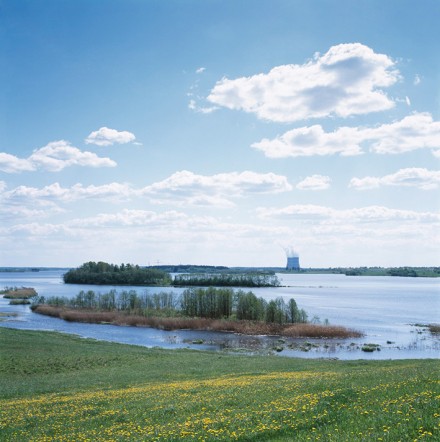
At the north end of the lake we spot a large stone monolith standing on a small rise. On closer inspection we see that there is a plaque attached to it celebrating the lives and talents of the artists who had painted here in the past. Levitan’s name is inscribed, we are in the right place. It is beautiful. The rise is awash with dandelions, the lake sparkles, ducks crash land in the water, wooded islands fringed with rushes dot the lake, two huge cloud making cooling towers sit on the horizon and little white clouds scud across the blue sky; more What a Great Day to be Alive than the pleasurable melancholy of Above Eternal Peace.
Lake Udomlya 19th May 2009
We arrive back at Polina’s Moscow kitchen around 9.30pm just in time to watch the sun dip behind the Kremlin.